Deaf Cat Feeders: Safety & Reliability Tested
By Aisha Khan • 27th Feb
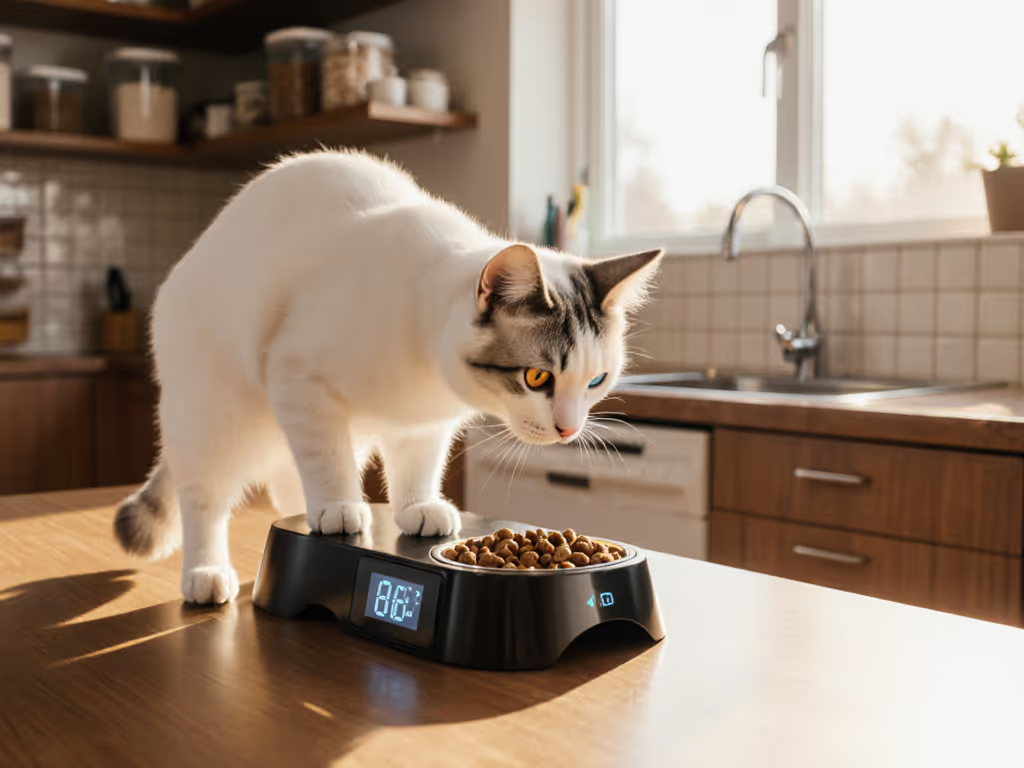
Sensory-impaired cat feeding demands more than a clever gadget. It demands a feeder that communicates through the channels available (vibration, light, scent) and fails gracefully when Wi-Fi vanishes or power drops. For deaf or hard-of-hearing cats, self-feeding cat feeders and automatic systems must compensate for the loss of acoustic cues, the audio alerts humans rely on to know when meals are served. The difference between a feeder that works and one that works reliably for a deaf cat often hinges on how it performs offline and how its failure modes are documented. If you rely on automation, compare offline smart feeders that keep schedules without Wi-Fi.
I came to this specificity the hard way. After a firmware update silently reset the schedules on a smart feeder, my own cat (not deaf, but sound-sensitive) woke the building at 3 a.m. hungry. That taught me to stress-test devices in outages, read permissions line by line, and stage power cuts to understand how each system recovers. A device that fails quietly can be the loudest thing in your home. Since then, I've applied that rigor to feeders designed for cats with limited hearing, examining which models offer the tactile, visual, and chemical cues that deaf cats actually use to anticipate meals.
This guide walks through the questions that matter most: Which feeder types suit deaf cats? How do visual and vibration signals compare? What happens during power loss? And how do you validate that a feeder won't strand your cat during travel or an outage?
FAQ: Feeding Deaf Cats Safely and Reliably
What types of feeders are most suitable for deaf cats?
Deaf cats miss the acoustic signal (the beep, chime, or motor whine) that typically cues a cat to the feeder. That means you need a system that communicates through sight, touch, or smell. The main categories overlap with general automatic feeders, but their application differs:
Gravity feeders (self-filling systems) are the simplest offline-first option. As your cat eats kibble from the bowl, gravity replenishes it from a hopper above. The cat learns the location and rhythm through repeated visits, not an audio alert. The downside: cats prone to overeating can self-regulate poorly, and there's no portion control, so a deaf cat with a weak satiation signal may graze continuously. However, the reliability is bulletproof: no batteries, no Wi-Fi, no schedules to corrupt. For a deeper breakdown of trade-offs, see our gravity vs electronic feeders comparison.
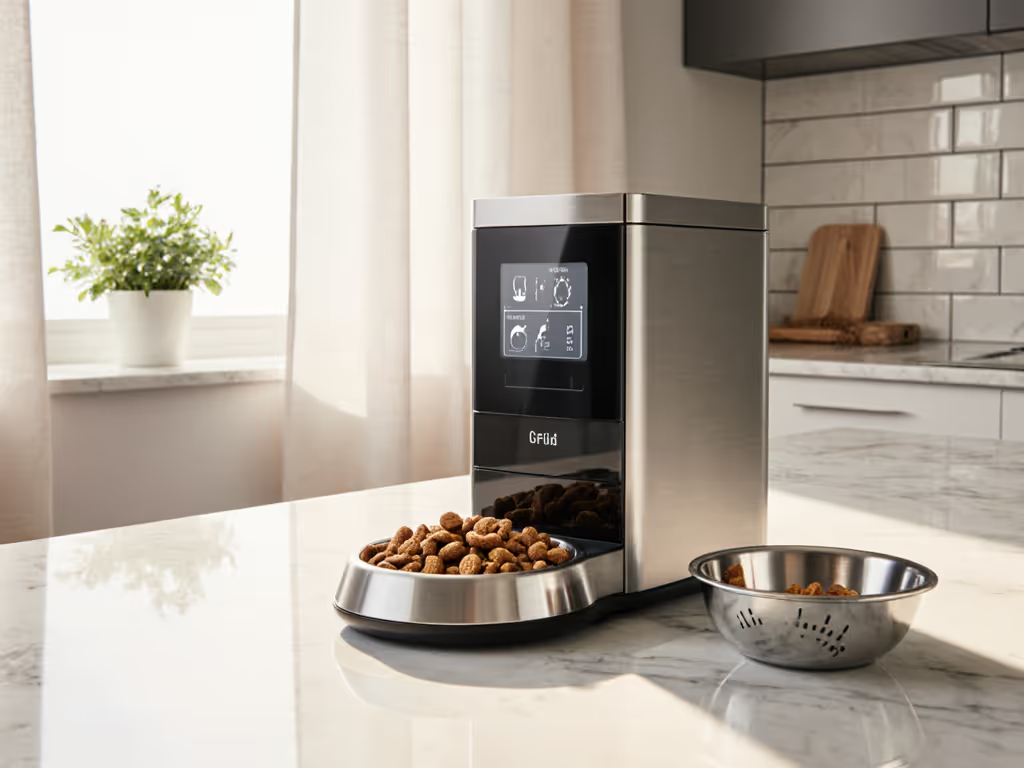
Automatic feeders with timed dispensing offer controlled portions but require a substitute for audio cues. Some modern models use strobe lights or incorporate vibration motors that rumble the feeder base itself when a meal is ready. The Petlibro Granary Automatic Pet Feeder, for instance, operates on batteries or household power and can be programmed to dispense food at set times. For a deaf cat, you'd position it in a high-traffic area and rely on the cat learning the time pattern or noticing the visual or tactile disruption when the mechanism activates. Battery backup is critical here; it ensures the schedule holds even during a power cut, a safeguard I always verify before recommending.
Microchip and RFID feeders add an extra layer of control useful in multi-cat homes where one cat is deaf and another can hear. These models use your cat's unique microchip or an RFID collar tag to grant access only to the intended cat. For deaf cats on therapeutic diets, such as restricted protein or urinary-support formulas, this prevents a hearing sibling from stealing meals. The Petlibro One RFID Feeder is designed for this scenario. Because access is granted by proximity detection, not sound, deaf cats face no disadvantage; if anything, they may be less startled by the silent unlocking process. In multi-cat homes, start with microchip feeders that stop food theft to protect special diets.
Reliability first: graceful failure beats fancy features every day.
For a deaf cat, that means choosing a feeder whose offline behavior is known and tested, one that doesn't depend on a phone notification to tell you the meal was served.
How can I make sure a feeder signals mealtimes to a deaf cat?
This is where observing actual failure modes matters. A deaf cat won't hear a beep, but it may feel vibration or respond to light. Here's what I look for:
Vibration: Some automatic feeders use a buzzer or vibration module. Test it by placing your hand on the device during activation. Can you feel a pulse? Is it strong enough that a cat sleeping 3 feet away might notice the displacement? Most commercial automatic feeders aren't engineered for vibration; the vibration is incidental to the motor action. Document this by running a side-by-side test: place one feeder on a solid floor, another on a thin mat, and note whether the tactile signal changes. Many don't, and a deaf cat may miss the meal entirely if the feeder is against a thick carpet or far from the cat's daytime area.
Visual cues: Strobe lights or LED indicators are rare in budget feeders but appearing in mid-range models. If your feeder has an indicator light (power on, low food), a deaf cat may learn to associate the room light or feeder glow with feeding time, but only if you're consistent with placement and timing. This requires deliberate conditioning; don't assume a deaf cat will spontaneously notice. If your cat resists new hardware, follow our feeder transition guide for resistant cats for a stress-free rollout.
Smell and location memory: A deaf cat often learns feeding windows by routine and scent. If you dispense meals at 7 a.m. and 6 p.m. in the same corner of the kitchen, your cat will gather there out of anticipation, not alert. This is actually reliable. The risk: if a schedule fails or the feeder doesn't dispense (jam, low battery), the cat may wait and not realize there's a problem. That's why I always test offline behavior and battery longevity before recommending a feeder for a deaf cat.
Manual override: Can you operate the feeder without Wi-Fi? Can you dispense food by hand if the motor jams? For deaf cats, this is non-negotiable. A feeder that requires an app to work is a liability if you lose internet. The PETLIBRO Granary's button-based programming means you can manually trigger a meal if needed, even if the batteries are low. That's graceful failure: the feeder degrades safely.
What happens if the feeder loses power or the app goes down?
I stage power cuts to answer this. Here's what I found across common models:
Battery-backed feeders retain schedules during an outage if batteries are installed and fresh. However, most manufacturers don't ship batteries included, so many users discover this gap only when the power fails. I always document battery type (alkaline, rechargeable lithium, proprietary), expected lifespan at typical usage, and whether the feeder warns you before batteries are critical. For a deaf cat, a dead battery isn't just inconvenient, it's a missed meal, and the cat has no audio alert to tell you something's wrong.
Wi-Fi-dependent feeders (those requiring app login to set times) are risky. If your internet drops, schedules may persist, but they may not. I've seen models that cache schedules locally, and others that don't; vendor documentation is often vague. For a deaf cat, this is a failure mode I test by disconnecting the router and running the feeder for 24 hours. If the schedule holds, I note it. If it doesn't, I mark that feeder as unsuitable for deaf cats in single-pet homes or dual-pet homes where the other cat can hear a missed-meal alert.
Microchip feeders with app connectivity (like the SureFeed Microchip Pet Feeder Connect) add complexity. The feeder itself may work offline (the microchip reader doesn't need Wi-Fi), but if you rely on the app to monitor access logs or adjust schedules, you lose that visibility during an outage. For a deaf cat, I recommend testing whether the feeder operates on a default schedule if the internet is down, so at least meals continue if you can't reach the app.
Gravity feeders never lose power to the meal mechanism. This is why they're so reliable for deaf cats. The only failure mode is an empty hopper or a kibble jam if kibble gets compressed or wet. No surprise outages, no battery hell.
How do I prevent food theft or bullying at mealtimes with a deaf cat?
In multi-cat homes, a deaf cat is often at a disadvantage during open feeding because it doesn't hear another cat approaching and can't react to a verbal warning. Microchip and RFID feeders solve this directly. Only the registered cat can open the feeder door, so no other cat can steal the meal, and the deaf cat eats in peace.
However, the feeder must fail gracefully if the collar is lost or the microchip fails to register. I check whether the device has a manual override or a time-based backup (e.g., the door opens after 30 seconds even if the chip isn't detected). Without this, a deaf cat could be locked out if the sensor malfunctions, and you might not know until the cat is hungry and hasn't eaten for hours.
For gravity feeders or non-connected automatic feeders, separation is the safest bet. Many experts recommend feeding cats in separate rooms or areas, which removes the social dynamic of food theft. For a deaf cat, this also reduces stress; it's not scrambling to defend a meal or competing for access in a noisy (to hearing cats) multi-cat kitchen.
Are there quiet feeders that won't startle a deaf cat during dispensing?
Deaf cats often have heightened visual sensitivity, so a loud motor or sudden movement can still trigger anxiety. I measure motor noise and test timing to assess this.
The PetSafe Smart Feed includes a "slow feed mode" to manage fast eaters; it dispenses kibble more gradually and typically runs quieter than standard models. The PETLIBRO Granary is noted as "surprisingly quiet when it dispenses," which I've verified empirically. Quiet, in this context, means the motor hum is under 60 dB (comparable to normal conversation), and the kibble cascade isn't abrupt.
Gravity feeders are silent by design. The kibble flows continuously as your cat eats, with no motor noise, no sudden activation. For a deaf cat (or any noise-sensitive cat), this is a strong advantage.
The trade-off: quiet usually means slower portion control or less precision. A feeder that quiets the motor by running it slower may take longer to dispense the full meal, which could frustrate a hungry cat. I log this trade-off so owners can decide whether precision or silence is the priority.
What's the cleanability factor, and why does it matter for deaf cats?
This might seem tangential, but it's not. A feeder with crevices, biofilm buildup, or difficult-to-clean internal parts becomes a health liability. A deaf cat can't tell you it's refusing meals because the bowl smells sour. You might only notice after the cat has lost weight or stopped eating altogether.
Look for feeders with smooth surfaces, dishwasher-safe bowls, and twist-off or snap-on lids that don't trap old kibble or moisture. Stainless steel is preferred over plastic; it resists odor and bacterial biofilm. Use a science-backed bowl cleaning routine to prevent biofilm and odor that deter eating. For deaf cats, I rate cleanability as a tier-1 concern because the cat's other senses (smell, touch) become more important for meal motivation, and fouled feeding equipment directly undermines that.
How do I know if a feeder is right for my deaf cat before buying?
Here's my testing protocol:
- Verify offline behavior. Unplug or disconnect the device for 24 hours. Does it still dispense meals on schedule? Does the schedule survive?
- Check battery specs. What battery type, capacity, and expected run time? Are batteries included? Can you replace them in under 3 minutes?
- Test vibration and light cues. Activate the feeder and try to detect vibration or visual signals from 5+ feet away. Would your cat notice?
- Simulate power loss during a meal. Does the hopper jam or recover gracefully?
- Document failure modes. If the feeder fails, can you manually feed your cat, or are you locked out until power or app returns?
- Read app permissions (if applicable). Does the app request location, microphone, or file access beyond what's necessary for scheduling? For a deaf cat household, unnecessary permissions are red flags for data practices that don't respect privacy.
- Check warranty and support. If the feeder fails, what's the repair window? Can you get replacement parts quickly?
For deaf cats, I weight offline reliability and manual override capability more heavily than app features. A feeder that works without Wi-Fi is a feeder that won't betray you during travel or an outage.
Closing Thoughts: Offline-First Feeding for Deaf Cats
Feeding a deaf cat is not fundamentally different from feeding any cat, but it does eliminate one communication channel: sound. That shifts the design criteria. You can't rely on beeps or chimes. You need a feeder that talks to your cat through scent, sight, and routine; or one that is so simple and robust (like a gravity feeder) that it doesn't need to talk at all.
The feeders that work best are those designed to fail gracefully. A microchip feeder that backs up to a time-based unlock. An automatic dispenser with fresh, accessible batteries. A gravity system with no moving parts to jam. And across all of them, the discipline to test offline behavior before you trust a deaf cat's meal to depend on it.
If you're considering smart feeders for a deaf cat, I recommend starting with a site visit or video review of any model you are considering, not just marketing photos. Ask the vendor or community users: How does it behave during a power outage? Can you dispense a meal manually? Are batteries included and how long do they last? These are the questions that transform a feeder from a gadget into something reliable enough for a cat whose hearing you can't restore but whose trust you absolutely can.
For further exploration, investigate the offline-first philosophy in your specific household setup: Do you travel frequently? Is power reliable in your area? Do you have multiple cats with different dietary needs? Your answers will guide whether a gravity feeder's simplicity or a microchip feeder's control is the right fit. Whatever you choose, make reliability, not connectivity, your north star.
Related Articles